
Microlearning Units (MLUs)
Explore these MLUs to deepen your understanding of key teaching principles and methods for English Language, Literature, and General Paper.
Last updated on 15 October 2026
View these Microlearning Units (MLUs) to understand and apply the principles, teaching processes and pedagogical approaches to the teaching of English Language, Literature and General Paper.
What's New
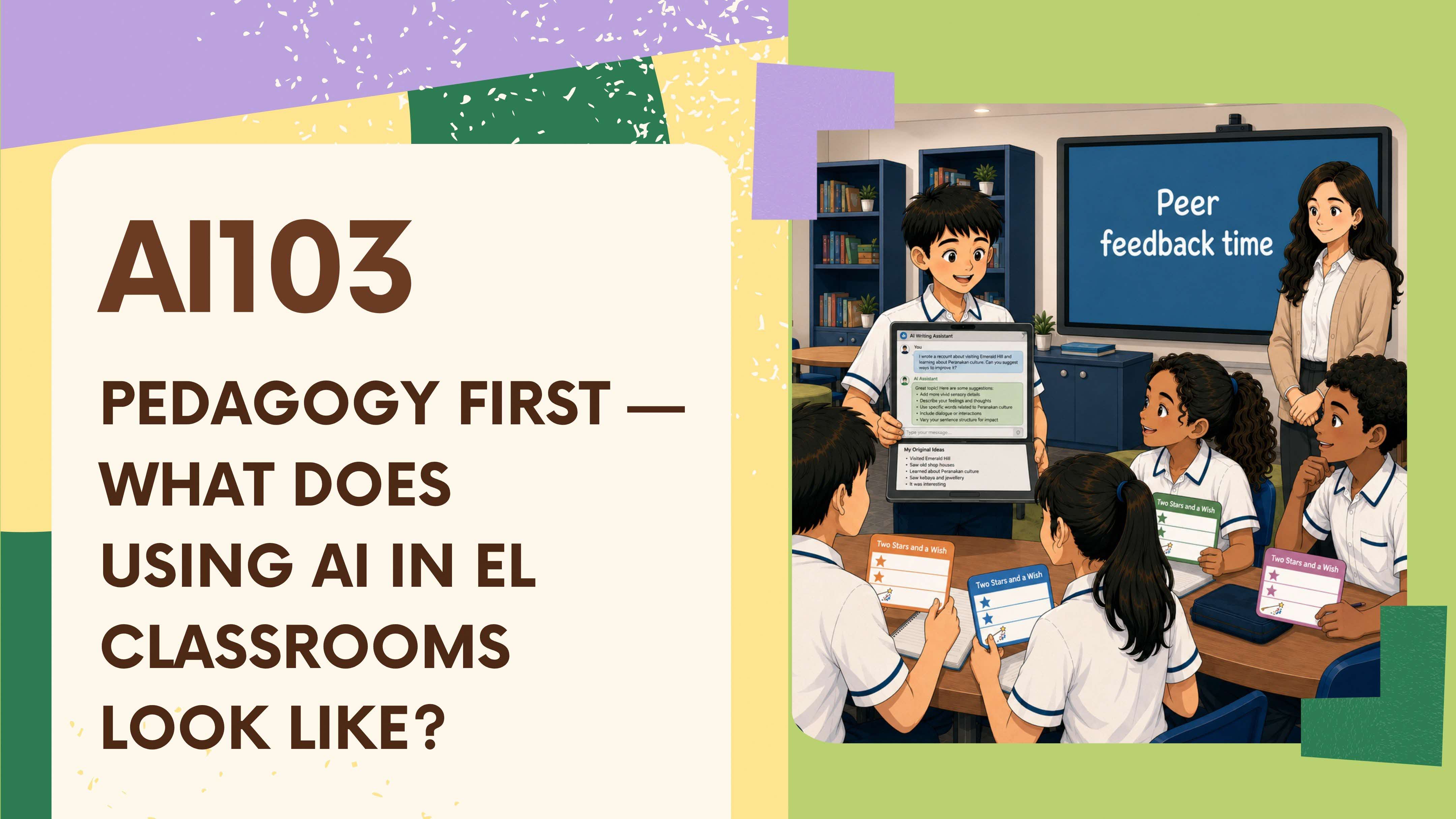
AI103: Pedagogy First — What Does Using AI in EL Classrooms Look Like?
This module examines the place of AI in the teaching, learning and assessment of English Language (EL), with a focus on the role of teachers of EL in making purposeful and pedagogically sound use of AI.
What Really Happens When You Listen and View?
In this Microlearning Unit (MLU), you will learn (1) what processes are involved in listening to and viewing texts, (2) how teachers can apply their understanding of these processes to inform their classroom practice and (3) why it is important for classroom practice to be informed by an understanding of these processes. [25/08, 10:48] Ynez (MOE): Reading and Viewing:

What Really Happens When You Read and View?
In this Microlearning Unit (MLU), you will learn (1) what processes are involved in reading and viewing texts, (2) how teachers can apply their understanding of these processes to inform their classroom practice and (3) why it is important for classroom practice to be informed by an understanding of these processes.
Microlearning Units
Teaching Principles and Processes: CLLIPS and ACoLADE
Planning the School-based EL Instruction Programme - How to Apply CLLIPS? (opens in new tab)
How can We Raise Awareness in the EL Classroom? (opens in new tab)
How can We Structure Consolidation in the EL Classroom? (opens in new tab)
How can We Facilitate Assessment for Learning (opens in new tab)
How can We Enable Application in the EL Classroom? (opens in new tab)
How can We Guide Discovery in the EL Classroom? (opens in new tab)
How can We Instruct Explicitly in the EL Classroom? (opens in new tab)
Inquiry-based Learning
Differentiated Instruction
Assessment for Learning
Why is it Important to Diagnose Students' Learning Needs? (opens in new tab)
What does Diagnosing Students' Learning Needs Involve? (opens in new tab)
Diagnosing Students’ Learning Needs – Frequently Asked Questions (opens in new tab)
Learning Path: Big Ideas of Effective Feedback (opens in new tab)
Big Ideas of Feedback (1) - Find and Fix Learning Gaps (opens in new tab)
Big Ideas of Feedback (2) – Motivating Students (opens in new tab)
Big Ideas of Feedback (3) – Self-directed Learners (opens in new tab)
Feeding Up: Help Students Understand Expectations of Learning (opens in new tab)
Promoting Dialogic Feedback: Help Students to Actively Seek Feedback (opens in new tab)
Feeding Forward: Help Students to Apply Feedback (opens in new tab)
Learning Path: Supporting the ABCs of Your Students’ Engagement with Feedback (opens in new tab)
Affective Engagement with Feedback: Build Students’ Confidence in Using Language (opens in new tab)
Behavioural Engagement with Feedback: Encourage Students’ Active Learning (opens in new tab)
Cognitive Engagement with Feedback: Deepening Students’ Understanding of Language (opens in new tab)
e-Pedagogy and Blended Learning
Using Questions to Deepen Learning
Selecting and Adapting Texts
Effective Communication for Learning
Learning Path: Facilitating Productive Classroom Discussion (opens in new tab)
Learning Path: Providing Language and Literacy Support in Subject Classrooms (opens in new tab)
Using the Frayer Model strategy to learn subject-specific vocabulary (opens in new tab)
Using the Concept Circle strategy to learn subject-specific vocabulary (opens in new tab)
Using the Semantic Feature Analysis strategy to learn subject-specific vocabulary (opens in new tab)
Using the Word Wall strategy to learn subject-specific vocabulary (opens in new tab)
Using the Annotating Texts strategy to learn subject-specific vocabulary (opens in new tab)
Using the Sequencing a Jumbled-Text strategy to learn subject-specific vocabulary (opens in new tab)
Encouraging Student Talk in the classroom (opens in new tab)
Classroom Inquiry
Knowledge about the Receptive and Productive Language Skills
Knowledge about English Grammar
How do I Determine the Word Class of a Word? (opens in new tab)
What are the Different Forms of Verbs and How do I Describe Them? (opens in new tab)
What are Adverbials? Why and How do I Use Them? (opens in new tab)
Subject-Verb Agreement: What Else Is There to Know? (opens in new tab)
How can We Make Texts Cohesive? – Using Grammatical Cohesive Devices (opens in new tab)
How can We Make Texts Cohesive? – Using Lexical Cohesive Devices (opens in new tab)
Coherence in Texts: What It Is and Why It Is Important (opens in new tab)