Classroom Inquiry of Manjusri Secondary School Teachers
Discover how Manjusri Secondary School teachers used GenAI tools to help students improve their writing. Read their reflections and findings from a classroom inquiry presented at the 2025 RELC International Conference.
Last updated on 6 October 2026
Classroom Inquiry of Manjusri Secondary School Teachers
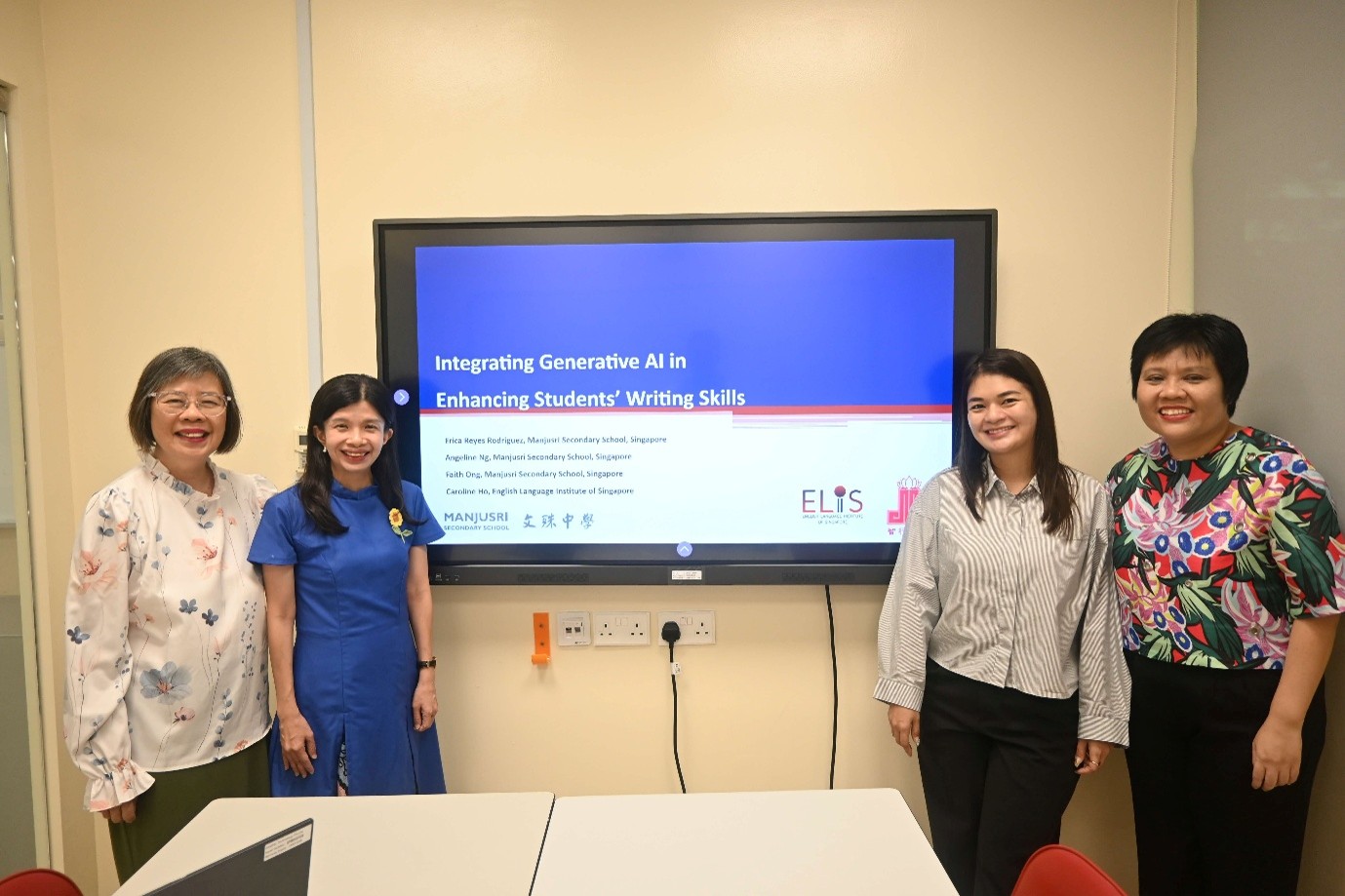
For many Lower Secondary students from non-English speaking home backgrounds, putting thoughts into words on paper can be a real struggle. Faith Ong (Lead Teacher/English Language), Angeline Ng and Erica Reyes Rodriguez (both English Language teachers) saw this in their G1 and G2 classes — and decided to meet their students where they were, starting with a shared love of technology.Supported by Dr Caroline Ho, Lead Specialist from ELIS, the teachers explored how Generative AI (GenAI) feedback assistants on the Student Learning Space (SLS) could strengthen their students’ skills in writing personal recounts. The results were encouraging – students showed a heightened awareness of language use in their writing and greater motivation to improve. The team went on to collaborate with Dr Ho to co-present their findings at the 2025 RELC International Conference.
.jpg)
Highlights of the teachers’ reflections on their learning:
The inquiry provided us an opportunity to question our assumptions about GenAI use in the writing classroom. Rather than view GenAI as either a threat to be feared or a shortcut for productivity, I helped the team develop a more nuanced stance on how GenAI could support students’ learning. For us, teacher judgement remains central. We play a critical role in guiding students to use GenAI with a critical eye. The “rise above” came when colleagues moved beyond isolated concerns over classroom tasks to developing a shared understanding of what matters in teaching writing. Conversations shifted from “What activity should I use?” to “What kind of writers are we developing?” and “How do we design lessons for transfer of learning and students’ discernment of key language skills required in writing mediated by AI?” Learning through inquiry further strengthened our collective understanding of Subject Content Knowledge (SCK) and Pedagogical Content Knowledge (PCK). We also worked towards a more thoughtful, responsive approach to writing instruction, coupled with a deeper understanding of the place of GenAI in the writing classroom.— Faith Ong
My personal takeaway from the inquiry was that while GenAI offers timely, individualised feedback and supports certain processes in the writing cycle, the time it frees up for the teacher is invaluable for students who need personalised guidance. Not all my students may know immediately what to do or how specifically to improve their writing from the GenAI-generated output. I’m convinced that GenAI will not replace the teacher in the classroom – we remain relevant and important to students’ learning. We are also the ones who impart good values such as respect, integrity and perseverance through the modelling of desired behaviour.— Angeline Ng
Learning from this inquiry reinforced the need to devote more time, where necessary, to the specific language features of personal recounts, highlighting the ‘why’ behind the ‘what’ required of this type of text. I would also demonstrate for my students how I act on feedback from Short Answer Feedback Assistant (ShortAns FA), making explicit what I decide to do for the specific purpose of the writing. By providing clear guidance while encouraging creativity and autonomy, I believe I can help my students build confidence in their writing and discover their unique voices. I aim to inspire in them a love for writing as a means for making meaningful connections and to deepen their appreciation for language in self-expression – this is what the human teacher, not GenAI, does best.— Erica Rodriguez